Hey oh y’all,
Hi everybody,
D/S: Happy New Year’s! Akemashite omedetou gozaimasu!
D: For our New Year’s posts, we decided to write our posts
together! After all, New Year’s is all about being together with your friends
and family, right Sumi-chan?
S: Yup, New Year’s is
all about fun times and looking forward to a new beginning. And that’s no
different here in Japan! We’re spending time with our Wakayama host family
enjoying many of the Japanese traditions here.
D: And it all starts with New Year’s Eve! And no Japanese
New Year’s Eve would be complete without NHK’s Kouhaku Uta Gassen (Red and
White Song Competition)! Just like America has the Times Square TV Countdown Concert,
Japan has its own concert celebration TV special. You can watch
the best of Japanese music hits compete in a 4-hour team special. Girl performers are red; guy performers are
white. If you know Japanese stars, both in and out of the music industry, this
is the show to watch.
S: Yup! This is just like the American Grammys, but no
commercials or long-winded speeches! Just cool hair, nice outfits, fun
performances, and beautiful stars!
 |
| Kouhaku! Hosted by boy band, Arashi! |
D: Are you talking about the AKB48 group Sumi-chan?
S: No, I was talking about the super cool boy band, Arashi.
Duh. Don’t you pay attention?
D: Apparently not, but can you blame me? The AKB girls are
pretty cute, and they sing well.
S: See David, this is why people think you are weird…anime
fan, AKB fan, Pokémon fan…sigh…
 |
| Come on Sumi. AKB48 is good! |
D: It’s purely educational. I’m exploring the culture. And
they did sing a fun version of Supercalifragilisticexpialidocious with Mickey
Mouse.
 |
| Japanese boy bands >>>>>>>> J-pop girl groups. -Sumi |
S: Sigh…why do I associate with this weirdo?
D: Because you love me?
S: No. Because Melissa paid me to come on this trip. Ahem…anyways,
this of course is not the only show to watch, but it is the most popular and
has been a Japanese staple for over 60 years.
 |
| Sumi-chan likes Arashi. |
D: Mochiron (of course). There are other channels showing
New Year’s specials, like Warrate wa Ikenai (Must Not Laugh). It’s a
pseudo-game show featuring 5 guys who are thrown into weird situations, and the
goal is to not laugh. Of course they do laugh, and the punishment is to get
spanked by a ninja. This repeats.
 |
| She really likes Arashi. |
S: Another weird show. I personally prefer Hajime no Otsukai
(My First Errand)! It’s so kawaii (cute). It features young children going on
errands alone. Sometimes they get lost, but in the end they complete their
mission!
D: Haha. Yeah. Well, it aint’ college football, that’s for
sure. But regardless of what you watch, probably the bigger tradition for New
Year’s Eve is eating soba (buckwheat noodles).
S: Mmmmm. Hot toshikoshisoba (year’s end soba) on a cold New
Year’s Eve! Very nice!
 |
| Toshikoshi soba! Mmm. |
D: Then there are kuromame (stewed black beans). They are
supposed to ward off bad luck and promote good health.
S: And of course, tai fish which we saw yesterday!
D: Yup. But most of the main dishes are for New Year’s Day.
After you stay up until midnight, you wait anxiously for New Year’s Day, which
in Japan, is the more important part of New Year’s. The New Year’s meal is very
important and is called osechi ryouri (New Year’s Food).
S: Now, osechi ryouri varies from region to region and even
from house to house, but there are many common dishes and they all represent
good health, fortune, and long life.
D: For example, eggs, which represent birth (life beginning
and fertility), are a common staple. For the more adventurous, fish eggs are an
even better example of this. Lots of eggs, lots of births. Then there is the lotus
root. The holes represent seeing a good future.
S: I prefer the shrimp. At least that tastes normal. Shrimp,
with the curved back, represents an old man.
D: Ahem, elderly…be respectful.
S: Sigh…elderly man. Anyways, the shrimp essentially symbolizes
a wish to be able to live until you are an “elderly” man.
D: Better. And on the topic of
older adult life, for those of age there is of course celebratory sake (rice wine). *Please
drink responsibly.*
 |
| Osechi Ryouri! Live Long and Prosper. |
S: But perhaps the most important
food is ozoni (mochi soup). Remember that mochi we made yesterday? Well, on New
Year’s Day, you put it into miso soup and eat it. It’s kinda soggy and chewy.
I’m not really sure what’s going on.
 |
| Ozoni! Mochi soup! |
D: Haha. Well, as you yourself
know, Sumi, it’s less about what you eat, but rather who you eat it with right?
S: Ah yup! The most important part
of a Japanese New Year’s meal is being able to eat it with family – that means
aunts, uncles, cousins, grandparents, and even deceased ancestors. Families
often eat near the family shrine.
D: But for those friends and family
you cannot eat with directly, it’s also important to keep in touch with them
too. Just as Americans send Christmas cards, complete with photos and a
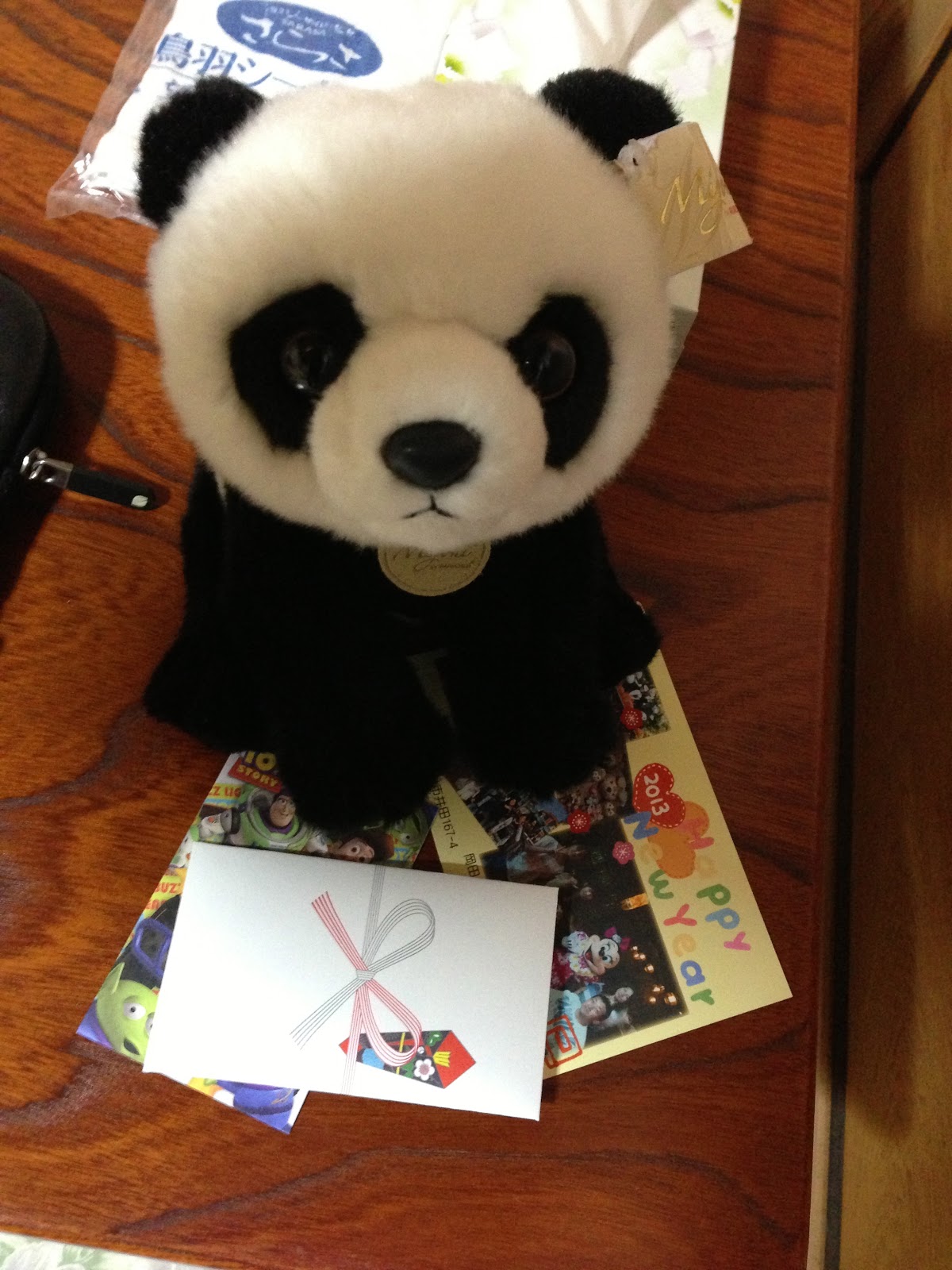
well-wishing message, so to do Japanese send nengajyou (New Year’s card). Cards
range from zodiac symbols, to family photos, to images of Disney characters. It shows your family is doing well and wishes the receiver a good year too.
S: But the more fun thing to
receive is otoshidama (New Year's gifts). Parents and relatives often give the children money as a New Year’s gift!
 |
| Yay! New Year's Cards and Gifts! Thank you |
D: I thought that was only for
Chinese New Year’s. You know, those red dragon envelope things.
S: Nope. It’s similar though.
D: Ah sou da naa (is that so?)?
Better thank our host family for the nice gift then.
S: Yup. Thank you and best wishes
to the kind Okada family for all their help this New Year’s season.
D: They were nice enough to let us stay with them for the busy New Year's even show us around the local temples and shrines in town.
 |
| Many Japanese towns have these smaller shrines. |
S: Another important tradition
is visiting the local temples and shrines. Just about town has at least a few
temples and shrines. Temples are Buddhist; shrines are Shinto. After you wash your paws and mouth, approach, donate, bow, clap, and pray.
 |
| Ring the bell for the shrine. |
 |
| Ring the bell for the temple. |
D: But you pray at both for
good luck and happiness. In fact, many temples and shrines are right next to
each other. Add in the Chinese zodiac influence (it’s apparently the year of
the snake), and distinguishing a distinct religion can be kind of confusing.
S: You also get to ring the bells. Sometimes there are really
cool big bells that you get to ring. Gongggggggg!
D: Haha. Yeah. Bells are important
features of both temples and shrines. I suspect when we visit Kyoto, we will be
doing a lot more bell ringing.
S: So let's ring in a good new year! But that about wraps up
our New Year’s post for today. Now to prepare for another tradition: after
holiday sales! But for us, we’ll also be traveling up to Kyoto tomorrow! See you soon!
Thank you for sticking with us and we wish you and your family a great year!
D/S: Akemashite omedetou! Arigatou
gozaimasu!
-Sumi, DC
PS. Tomorrow Stanford is playing in the Rose Bowl! Good luck and Go Cardinal!